Terasol Energy

Beyond the Shine: Essential Role of Solar Encapsulants

WHAT IS AN ENCAPSULANT?

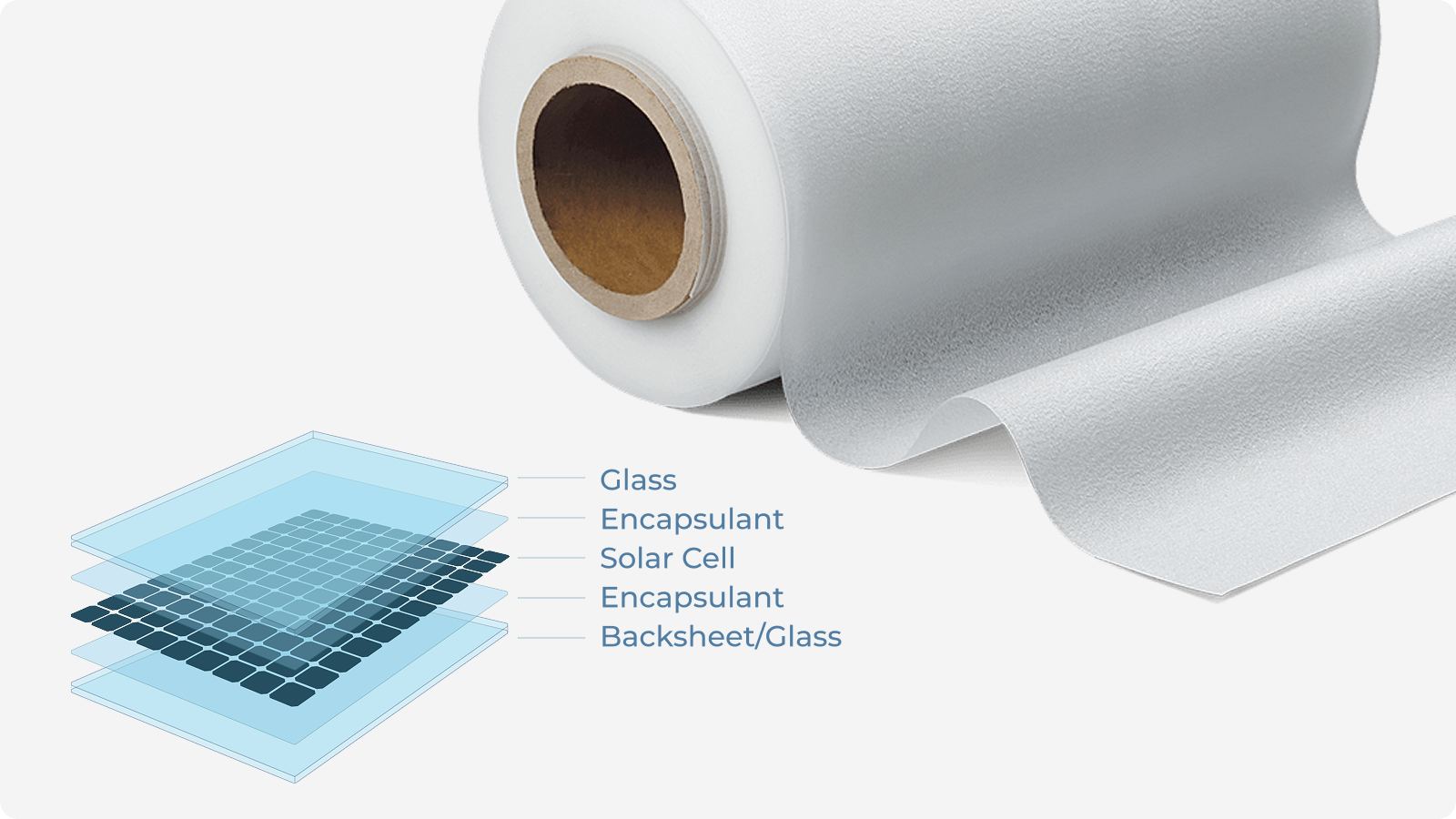
An encapsulant is a polymer film that surrounds solar cells in photovoltaic modules before lamination. During lamination, it melts, flows, and then solidifies, binding all components (glass, cells, interconnect ribbons, and backsheet/rear glass) into a single, weather-tight unit.


WHY ENCAPSULANTS MATTER

In solar energy, while components like glass and frames are often noticed, solar encapsulants are the critical, often overlooked, transparent films that determine a module’s power output and longevity. These films, nestled between layers, orchestrate performance. At Terasol Energy, we specialize in durable, high-performing EVA, POE, and EPE films, because we recognize that the right encapsulation solution is fundamental to advancing the global solar transformation.

SOLAR ENCAPSULANTS: KEY FUNCTIONS AND PERFORMANCE

❖ Protection & Barriers
  • Moisture Protection
  • UV Resistance: Prevents yellowing that reduces efficiency by up to 2%
  • Environmental Shield: Protects against dust, dirt, and temperature extremes
❖ Mechanical Support
  • Thermal Stress Absorption: Manages expansion mismatch between silicon.
  • Micro-crack Prevention: Protects cells from mechanical stress and impacts
  • Structural Integrity: Maintains module stability under mechanical loads
❖ Electrical Performance
  • Volume Resistivity: ≥1015 Ω·cm prevents current leakage
  • PID Prevention: POE reduces potential-induced degradation by 70% vs EVA
  • Insulation: Prevents short circuits and electrical failures
❖ Optical Coupling
  • Light Transmission: >92% ensures maximum photon delivery
  • Refractive Index Matching: Minimizes reflection losses (n≈1.48)
  • Optical Clarity: Maintains transparency for 25+ years
❖ Adhesion
  • Peel Strength: Over 80 N/cm-1
  • Long-term Bonding: Maintains structural integrity for 25+ years
  • Layer Adhesion: Bonds glass, cells, and backsheet components

EVOLUTION OF ENCAPSULANT CHEMISTRIES

MATERIAL CORE STRENGTH TYPICAL WEAKNESS WHERE CAN IT BE USED
EVA (Ethylene-Vinyl Acetate) Excellent adhesion, wide lamination window, low cost Hydrolysis forms acetic acid → PID risk; UV yellowing above 90 °C if poorly stabilized Glass-backsheet PERC modules
POE (Polyolefin Elastomer) Low WVTR, acid-free, high PID resistance Higher price, processing narrower TOPCon & HJT Bifacial glass-glass lines
EPE (EVA-POE-EVA tri-layer) Combines EVA adhesion with POE moisture barrier; balanced cost-performance Slightly more complex lamination Utility-scale modules in humid or coastal sites

MODERN CELL TECHNOLOGIES AND RECOMMENDED ENCAPSULANTS:

1. TOPCon & HJT cells
  • Lower doping and thinner passivation layers for their moisture-sensitivity characteristics.
2. Bifacial & glass-glass modules
  • With transparent backsheets gone, the rear encapsulant doubles as an optical layer. EPE’s central POE keeps WVTR low while outer EVA layers bond to glass, preserving yield in deserts and coastal wind farms.
Terasol encapsulants provide superior results such as:
  • Shrinkage below 3%
  • Gel Content exceeding 80%
  • Volume Resistivity greater than 1×10^15 ohm-cm
  • Peel Strength over 80 N/cm

Our proven solar encapsulants will enhance the reliability and durability of modules. Reach out to us today to discover how we can power your projects with performance-driven, long-lasting solutions.

×